
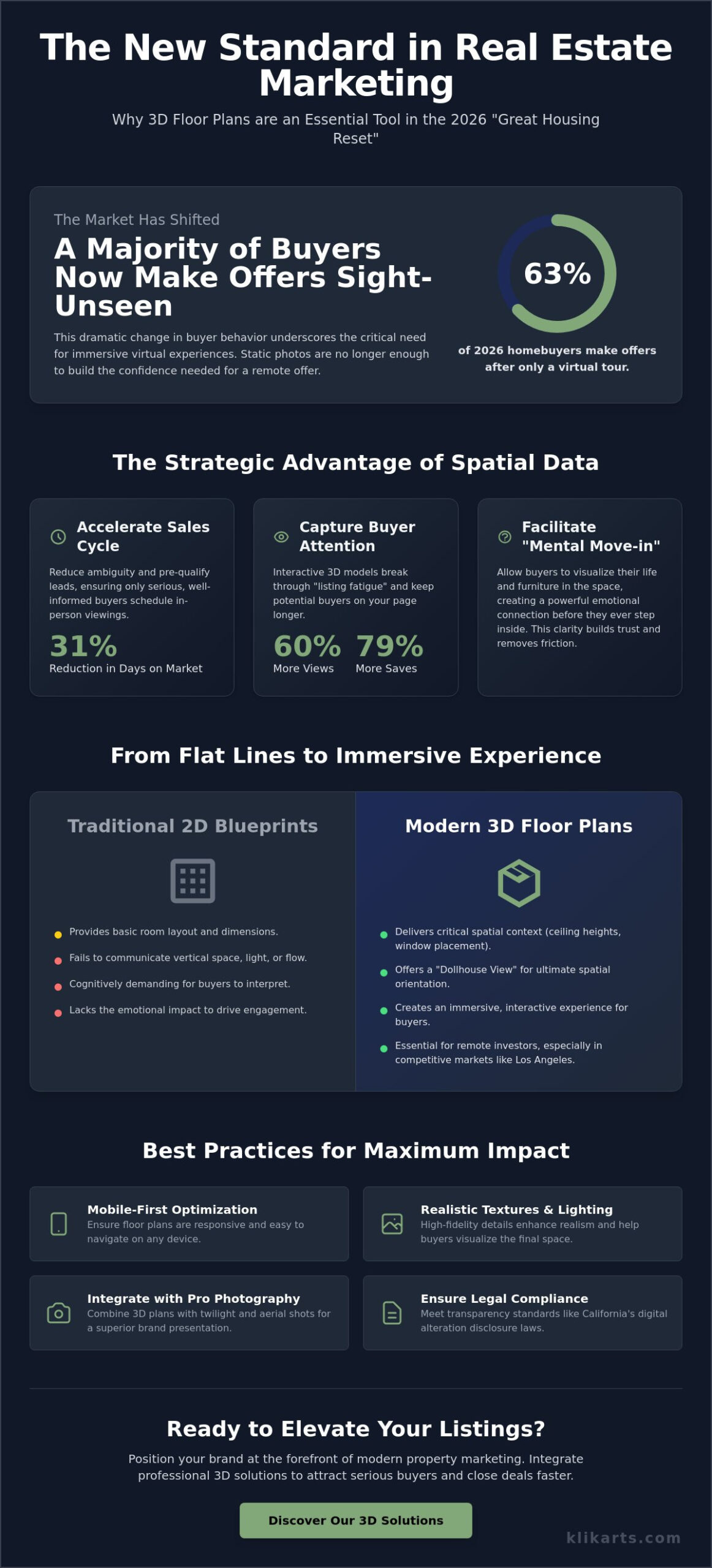
Did you know that 63% of homebuyers in 2026 are now making offers on properties they’ve only toured virtually? This shift highlights why a high-quality 3D floor plan real estate strategy is no longer a luxury. It’s a fundamental requirement for staying competitive during the “Great Housing Reset.” You likely recognize the frustration of watching potential buyers bounce from your listings because they can’t visualize the flow of a home through static photos alone. It’s a common hurdle that slows down transactions and limits your reach to out-of-state investors.
This article will demonstrate how 3D floor plans transform these static images into immersive spatial experiences that drive engagement and accelerate the sales cycle. You’ll learn how these tools bridge the gap between looking at a house and living in a home while meeting the latest transparency standards. We’ll explore the strategic benefits of spatial data, from reducing days-on-market by 31% to managing the new CaliforniaF digital alteration disclosure laws that went into effect this January. By the end, you’ll understand how to position your brand at the forefront of modern property marketing.
Key Takeaways
- Understand why high-fidelity spatial models have evolved from premium extras into a mandatory standard for high-end listings in 2026.
- Learn how a 3D floor plan real estate strategy facilitates the “mental move-in” effect, effectively removing buyer friction before the first physical showing.
- Compare the technical utility of 2D layouts with the emotional impact of 3D renderings to find the optimal marketing mix for your property.
- Identify professional implementation techniques, including mobile-first optimization and realistic textures, that significantly enhance listing engagement and lead quality.
- Discover how to leverage local Southern California expertise to integrate these spatial tools with twilight photography for a superior brand presentation.
The Evolution of Listing Visuals: Why 3D Floor Plans Matter in 2026
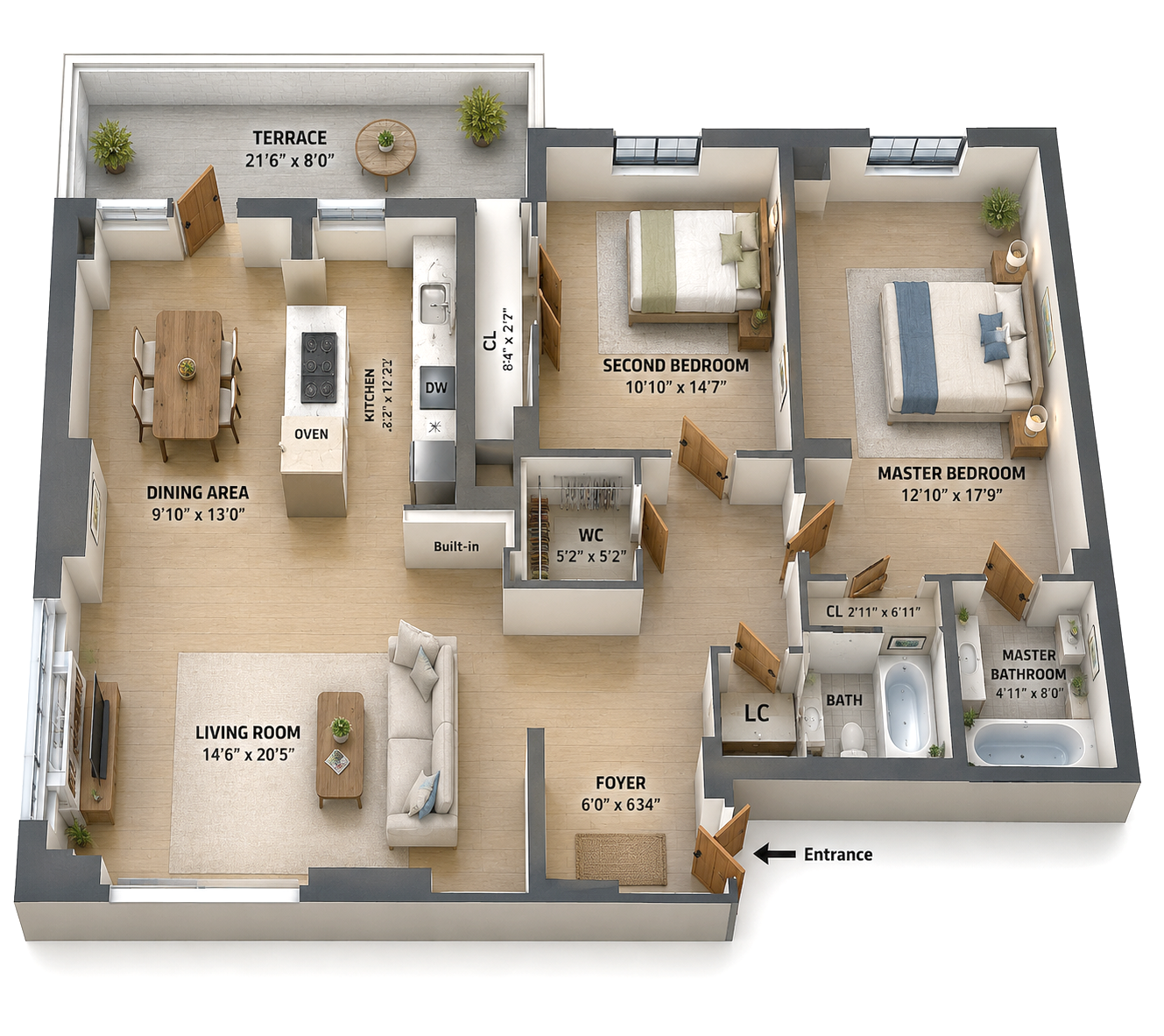
The real estate industry has undergone a fundamental shift in how properties are presented to the public. A 3D floor plan real estate model is no longer just a digital novelty; it’s a high-fidelity, three-dimensional representation of a property’s layout that provides essential spatial context. In 2026, buyers are increasingly selective. This period, often called the “Great Housing Reset,” is defined by increased buyer leverage and a demand for data-driven transactions. Buyers now prioritize listings that offer complete spatial transparency before they ever commit to a physical showing. If a listing lacks this clarity, it’s often ignored in favor of more transparent competitors.
Active home seekers frequently experience “listing fatigue” from scrolling through hundreds of near-identical photos. 3D visuals break this cycle by providing a structured, interactive way to understand a home. Statistics from 2026 show that interactive floor plans generate approximately 60% more views and 79% more “saves” than static images alone. This level of engagement is critical for moving a lead from casual browsing to serious consideration. By providing a clear roadmap of the property, you reduce the psychological barrier to entry for the buyer.
Beyond the 2D Sketch: The Depth Advantage
Traditional blueprints serve a functional purpose, but the evolution of floor plans has moved toward immersive depth. While 2D sketches provide a flat overview, 3D plans offer critical vertical context, including ceiling heights, window placements, and the relationship between different levels. This is vital for modern open-concept homes where the “flow” is often lost in a standard photo gallery. 2D plans frequently fail to communicate how light moves through a space or how rooms connect vertically. The dollhouse view serves as the ultimate spatial orientation tool, allowing buyers to see the entire home as a single, cohesive structure.
Los Angeles Market Dynamics: Standing Out in a Sea of Listings
The Los Angeles residential market is uniquely hyper-competitive and moves at an aggressive pace. With a high volume of international and out-of-state investors looking at Southern California, providing a clear understanding of an architectural layout through a 3D floor plan real estate model is a strategic necessity. 3D plans cater to these buyers by offering a reliable way to verify that a property meets their functional requirements from thousands of miles away. Immersive visual content correlates directly with higher engagement on local MLS portals. In a market where every detail counts, professional 3D renderings provide the competitive edge needed to capture the attention of high-net-worth individuals and serious investors who value their time and precision.
How 3D Floor Plans Reduce Buyer Friction and Increase Engagement
The most common objection real estate agents hear isn’t always about the price. It’s often about the fit. Prospective buyers frequently walk away because they can’t determine if their existing furniture will work in the space. By integrating a 3D floor plan real estate model, you eliminate this uncertainty immediately. A 2026 survey indicates that accurate room measurements and detailed floor plans are now the highest priority for homebuyers, even outranking the quantity of photos. This transparency builds a foundation of trust. It shows the property exactly as it exists, without the distortion of wide-angle lenses.
This clarity leads to the “mental move-in” effect. When a buyer can see the relationship between the kitchen and the patio in three dimensions, they begin to visualize their daily routines. They aren’t just looking at a house; they’re planning where the morning coffee happens. Top-producing agents are increasingly using these virtual listing tools to create this emotional connection before a physical tour even begins. This pre-qualifies leads. It ensures that the people who request a showing are already comfortable with the layout. It effectively reduces wasted showings and saves time for everyone involved.
Solving the Spatial Awareness Gap
Translating a 2D image into a 3D mental map is cognitively taxing. Most people struggle to stitch together separate photos of a hallway and a bedroom into a cohesive understanding of a home. 3D floor plans act as a spatial bridge, doing the heavy lifting for the human brain. This is particularly vital for long-distance relocation decisions. For out-of-state buyers, this visualization is often the deciding factor in making an offer. If you’re looking to enhance your listings, you might consider how professional spatial modeling can bridge this gap for your clients.
Increasing Time-on-Page and Listing Ranking
Interactive content does more than just please buyers. It signals quality to search algorithms on major platforms like Zillow and Redfin. These portals prioritize listings that keep users engaged for longer periods. Interactive media also drives social media shareability. Users are more likely to send a 3D floor plan real estate model to friends or family than a static gallery. Longer time-on-page directly correlates to higher lead conversion rates. Every second a buyer spends exploring your 3D layout is a second they aren’t looking at a competitor’s listing. This increased engagement helps your property climb the rankings and stay visible to active seekers.
Comparing 3D Floor Plans with 2D Layouts and Virtual Tours
Choosing the right visual assets requires a strategic understanding of how different formats influence buyer behavior. Traditional 2D plans remain essential for technical accuracy and appraisals. They provide the precise dimensions necessary for contractors or architects. However, they often lack the emotional resonance required to convert a casual browser into a committed buyer. A 3D floor plan real estate model occupies the critical “sweet spot” in modern marketing. It combines the structural clarity of a blueprint with the aesthetic appeal of a high-end rendering, allowing buyers to appreciate both the logic and the beauty of a home simultaneously.
Virtual tours and video walkthroughs offer deep immersion, but they can occasionally become disorienting. Without a spatial reference point, a viewer might lose track of where the primary suite sits in relation to the living area. The most successful listings in 2026 utilize a multi-layered visual strategy. This approach uses 2D plans for data, 3D models for orientation, and video for emotional storytelling. By layering these assets, you provide a comprehensive information package that answers every possible buyer question before it’s even asked.
When to Use 3D Over 2D: A Decision Framework
While 2D plans are a baseline requirement, certain scenarios demand the added depth of 3D. If a property features architectural complexity, such as split levels or unique vaulted ceilings, 3D is non-negotiable. It’s also the superior choice for “empty” or unfinished listings. When integrated with virtual staging, a 3D plan allows you to showcase the potential of a space without the cost of physical furniture. Agents should prioritize 3D renderings for mid-to-high-tier listings where the target demographic expects a tech-forward presentation. The investment in 3D visualization pays dividends by attracting higher-quality leads who already understand and appreciate the property’s layout.
The Synergy of 3D Plans and Video Walkthroughs
Think of the 3D floor plan as the “map” and the listing video walkthrough as the “journey.” When these two assets work together, they provide a seamless narrative. High-end listing websites often use the 3D model as an interactive navigation tool, allowing users to click a room in the plan to jump to that specific point in the video. For properties with significant acreage or complex exteriors, integrating drone deploy measurements with 3D models ensures continuity between the interior flow and the exterior landscape. This level of professional integration creates a cohesive brand image that positions the agent as a meticulous and dependable expert in their field.
Maximizing ROI: Best Practices for Implementing 3D Floor Plans
Implementing a 3D floor plan real estate strategy requires more than just generating a model; it demands a tactical approach to distribution and presentation. In 2026, mobile-first optimization is mandatory. Most buyers view listings on smartphones while on the go. High-fidelity renders must load instantly to prevent bounce rates and maintain the viewer’s attention. Clarity is equally important. Ensure that labels are legible on smaller screens and that the navigation is intuitive for touch-based interaction. If the interface is clunky, the buyer will simply move to the next listing.
The quality of the rendering directly impacts the perceived value of the property. Avoid sterile, clinical designs that feel like architectural drafts. The current trend favors a realistic “lived-in look” that includes emotive details. Subtle touches, such as a coffee cup on a kitchen island or shoes by the entryway, help buyers visualize their own lives within the space. Lighting also plays a crucial role. Accurate shadows and natural light simulations create a sense of warmth and realism that static, flat images cannot replicate. This level of detail transforms a technical drawing into a powerful emotional marketing tool.
Strategic placement within your listing sequence is vital for maximum impact. Do not bury the 3D plan at the end of the photo gallery. Position it within the first five images. This ensures that the buyer establishes a clear spatial mental map before they dive into the detailed room photos. For social media marketing, utilize screen recordings of the 3D model for Instagram Reels or Facebook. Dynamic pans across the layout create thumb-stopping content that highlights the home’s flow much more effectively than a single still image.
Digital Staging: Furniture Placement and Scale
Empty floor plans often feel cold and uninviting. Digital furniture provides a sense of scale and purpose, showing buyers exactly how a room can be utilized. It’s critical to ensure that every piece of virtual furniture is accurately scaled to the room’s dimensions. Misleading buyers with undersized furniture can damage trust and lead to negative feedback during physical showings. Use these plans to emphasize lifestyle features like dedicated home offices or accessory dwelling units (ADUs), which are high priorities for the 2026 market.
Cross-Platform Optimization
Your visual assets must perform across various platforms, from the MLS to private property sites. While Zillow and local portals require fast-loading, compressed files, your own website can host higher-resolution interactive versions. For high-end Los Angeles open houses, printed brochures remain a powerful touchpoint. High-resolution outputs are essential for print to maintain a premium brand image, whereas web versions must prioritize load speed and interactivity to keep users engaged. To secure the best results for your next listing, order a professional 3D floor plan to elevate your marketing strategy.
Elevating Your Los Angeles Listing with Klikarts 3D Solutions
In a market as sophisticated as Southern California, a standalone 3D floor plan real estate model is no longer enough to move the needle. Klikarts Photography provides a cohesive marketing ecosystem by integrating these spatial models with professional residential home photography and striking twilight photography. This holistic approach ensures that every visual asset works in harmony to tell a compelling story. Our team possesses deep expertise in Southern California architectural styles, from mid-century modern to contemporary hillside estates. We understand how to highlight the unique flow of these homes, ensuring the 3D model captures the essence of the property’s design while meeting the transparency standards required by modern buyers.
Precision is the cornerstone of our process. We combine Drone Deploy Measurements with advanced 3D modeling to ensure total interior and exterior continuity. This data-driven accuracy is essential for high-stakes listings where investors demand verified spatial data before committing to an offer. For urgent situations, we offer 24/7 emergency photography services to ensure your listing goes live without delay. This reliability makes us a trusted partner for agents who need to move quickly in the competitive Los Angeles landscape. We don’t just provide images; we provide a strategic advantage that instills confidence in your clientele.
The Klikarts Photography Integrated Media Workflow
Efficiency is paramount for busy real estate professionals. Klikarts Photography operates as a one-stop-shop, handling professional photography, listing video walkthroughs, and 3D floor plans in a single visit. This integrated workflow guarantees absolute consistency in branding across all digital platforms. You won’t have to manage multiple vendors or worry about mismatched visual styles. Instead, you get a single point of contact for all your digital marketing needs. This streamlined process allows you to focus on client relationships while we handle the high-performance technical execution.
Fast Turnaround for the Fast-Moving LA Market
The Los Angeles market waits for no one. We’ve built our reputation on meeting the demands of quick-close listings without compromising on visual quality. Every project undergoes professional image enhancement editing to ensure the final output meets our high standards for excellence. Our commitment to 3D precision means you receive a product that is both beautiful and technically sound. Don’t let your listing get lost in the noise of a crowded market. Schedule your 3D floor plan and photography session with Klikarts Photography today to secure your competitive edge and drive measurable success for your clients.
Securing Your Competitive Edge in the 2026 Market
The real estate landscape of 2026 demands a shift from simple documentation to immersive storytelling. By adopting a 3D floor plan real estate strategy, you provide the spatial clarity that modern buyers require to make confident, long-distance decisions. These models effectively reduce buyer friction and create a “mental move-in” effect that traditional photos simply can’t match. Success in the current market depends on your ability to offer total transparency through high-fidelity data and realistic visualization.
Klikarts is ready to be your strategic partner in this high-performance environment. We combine specialized Los Angeles real estate knowledge with expert Drone Deploy precision measurements to deliver unmatched accuracy for every listing. Whether you’re navigating a luxury estate or a high-stakes residential sale, our 24/7 emergency photography availability ensures you never miss a critical market window. It’s time to elevate your professional brand and drive measurable results for your clientele.
Book Your Professional 3D Floor Plan and Photography Package Today and position your listings at the forefront of industry innovation.
Frequently Asked Questions
Do 3D floor plans really help sell homes faster?
Yes, properties with floor plans and virtual tours sell up to 31% faster than those without. This data from 2026 confirms that providing a 3D floor plan real estate model significantly reduces the time a listing spends on the market. Buyers feel more confident making offers when they have a clear understanding of the spatial layout. This increased transparency leads to higher quality leads and more efficient closing processes for busy agents.
How much do 3D floor plans cost for a standard residential listing?
Costs for a 3D floor plan are typically based on the square footage and the level of detail required for the rendering. Since every property is unique, pricing is customized to ensure you only pay for the specific value you receive. For a detailed quote on your next listing, it’s best to contact a professional service provider directly. This ensures that the technical requirements of your specific Southern California architectural style are fully addressed.
What is the difference between a 3D floor plan and a virtual tour?
A 3D floor plan provides a bird’s-eye, “dollhouse” view of the entire property layout at once. In contrast, a virtual tour offers a first-person, room-by-room walkthrough experience. While the virtual tour provides immersion, the 3D plan provides the essential spatial orientation needed to understand how those rooms connect. Using both together creates a multi-layered marketing strategy that answers every buyer’s question about the home’s flow and functionality.
Can I use 3D floor plans on Zillow and the MLS?
Yes, you can easily integrate a 3D floor plan real estate model into Zillow, Redfin, and most local MLS portals. These platforms allow you to upload high-resolution renders as part of your photo gallery or as a dedicated interactive link. Including this content often improves your listing’s visibility within search algorithms. Platforms prioritize high-engagement media because it keeps users on the page longer, which directly benefits your property’s ranking and reach.
How long does it take to create a 3D floor plan?
Most professional 3D floor plans are delivered within 24 to 48 hours after the initial property scan or site visit. This timeframe allows for precision modeling, texture application, and professional image enhancement editing. While larger luxury estates or complex commercial properties might require additional processing time, the goal is always to meet the fast-moving demands of the Los Angeles market. Efficiency in delivery ensures your marketing materials are ready for the listing’s debut.
Do I need to provide my own blueprints to get a 3D floor plan?
You don’t need to provide existing blueprints or architectural drawings to receive a high-quality 3D model. Professionals use advanced laser measurement tools and drone deploy measurements to capture the property’s dimensions accurately on-site. This data is then used to build the model from the ground up, ensuring that the final output reflects the current state of the home. This approach is much more reliable than relying on potentially outdated original construction documents.
Are 3D floor plans accurate enough for appraisals?
3D floor plans are primarily designed as powerful marketing tools rather than technical appraisal documents. While they are highly accurate for visualization and furniture planning, appraisers often require specific 2D technical plans that include precise wall thicknesses and structural details. It’s best to use the 3D model to drive buyer engagement and the technical 2D layout for the formal valuation and legal components of the transaction.
Can you add furniture to a 3D floor plan if the house is empty?
You can definitely add digital furniture to a 3D floor plan to showcase the potential of an empty home. This process, often part of a virtual staging service, helps buyers understand the scale and purpose of each room. Seeing a bed in a bedroom or a desk in a home office makes the space feel lived-in and functional. It’s a cost-effective way to present a finished look without the logistical stress of physical staging.